A Weekend in Amsterdam with Boris
Back to home pageI first met Boris nearly 20 years ago in Moscow. We stayed in contact by letter, then fax and now email. This is the fourth time I've seen him. He had business in Amsterdam in October 2006, so we spent the weekend with him.
Below are some photos with a narrative in the captions beneath each photo.
Click on a smaller image below to see a larger version of the picture. When viewing a larger picture, clicking "Next" allows you to look at the larger pictures one at a time.
Even the larger versions of these images are not of sufficient resolution for a quality print. If you would like a higher resolution printable picture, please let me know.

Here Boris is dispelling the image of Russians always being serious. He is sitting in a plastic model of a wooden Dutch shoe that is in front of an Amsterdam souvenir shop.

The oldest church (Oude Kerk, Old Kirk) in Amsterdam at night.

Boris took this picture of bicycles locked to the railing of a canal bridge. I wish we had taken more pictures of the bicycles.
Amsterdam and all of the Netherlands is so flat that cycling is very common. There are bicycles of every possible description everywhere. In the city center there are far more people cycling than in cars. The cycle users are young, middle-aged and old, female and male, well dressed and not. There appear to be no social classes that do not cycle. There are separate cycling lanes in some streets, separate from the car lanes, the walking space and the tram lanes. In a few cases the cyclists have their own signal light at intersections. I wish I had taken some photos of the variety of cycles and the vast number of them. At the central railway station there must have been a thousand bikes locked to railings. Many of the bikes are sturdy basic ones without gear shifting and with high handle bars so the rider sits upright. Almost none of the cyclists wear helmets, perhaps because they feel they don't ride fast or far.
Being a pedestrian is disconcerting because one can step from the walking space into a cycling lane without noticing. Since bikes are silent compared to motorized vehicles, pedestrians are at risk of being hit.
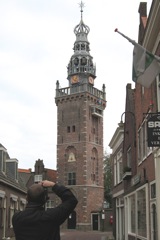
The clock and bell tower in the fishing town of Monnickendam. Boris is snapping a similar photo.

A few traditional Zuider Zee boats in the Monnickendam inner harbor. Note the sideboards that can be raised and lowered, rather than a keel, for sailing in shallow water. The masts can be lowered for going in canals beneath bridges.

The bridge across the canal can be manually raised to let boats pass.

The dike at Volendam is lined with souvenir shops, which look down into the harbor.

These starlings were sitting on the railing waiting for food from the tourists a few feet away.

A bronze statue of a Dutch sailor in his wooden shoes, with a Russian visitor holding up two fingers behind his head.

We got ice cream cones at one of the tourist shops along the dike.

This relatively small windmill was turning and pumping water from a drainage ditch beside a field to a higher level canal. That is the traditional method of keeping farms and villages from flooding.

Across the field are three large windmills, all rotating in the breeze.

Many of these pictures show grey skies, but the sun shown through from time to time, as when this photo was snapped.

The three windmills are on the bank of the River Zaan. Before electric motors and steam engines, this was perhaps the largest industrial area in the world. At one time there were about a thousand windmills in the area.

The shafts and gears on the interior of the windmill are made almost entirely of wood, with a few iron bolts and other fittings. Each gear tooth can be replaced when it wears out.
The windmill we toured powers three machines, two different grinders and a chopper. The chopper was, and still is, used to chop up tree bark as the first step in making dye coloring. One of the grinders is used for grinding limestone into powder. In this case the powder is used as chalk base for paint dyes. That is why there is white dust on the gear wheel in the photo. The other grinder is in a separate room away from the limestone dust, because it is used to grind various dye materials into powder.
The gears allow the wind power to be directed to one or more of the machines. Each grinder is a pair of granite wheels weighing six or seven tons each that roll around a shallow iron container to crush what ever is being milled. It is an impressive set of machines, that resourcefully uses materials available 200 and 300 years ago.

This guy is making a wooden shoe. He clamped a pattern shoe into the machine, and then uses the machine to cut an identical shoe from a block of wood. The floor is covered with wood chips. Wooden shoes were worn for centuries by all Dutch working people, male and female. Fishermen and farmers working in the drainage ditches made boots by tacking leather leggings to their wooden shoes. For weddings they made highly decorated wooden shoes. During the Nazi occupation when wood for new shoes was hard to get, they repaired worn out shoes by nailing on new wooden soles.

There is a statue in the town of Zaandam commemorating Russian Czar Peter the Great who came to the Netherlands in 1698 to learn ship building. When he went back to Russia, he built a Russian fleet and a new port city which is named for him, St. Petersburg.

The two evening meals we had in Amsterdam were mediocre, but the meal we had in Zaandam was excellent. In this picture we are perhaps looking hungry for the meal we have just ordered.
We saw quite a few things of which there isn't photographic evidence. It seems that I only sometimes remember to capture a photo to remember things.
In Amsterdam there are canals every few blocks. In historic times the buildings lining the canals were sometimes warehouses. There is a strong timber beam extending from the peak of the roof, from which heavy goods can be lifted via block and tackle to doors on each floor. Some of the canals and bridges are picturesque, but I neglected to get any photos.
We visited the Amsterdam Historical Museum, that has a strikingly complete presentation of how the city evolved from a bog. A thousand years ago the Netherlands was a sand beach along the North Sea with vast peat bogs to the interior of the sand dunes. Humans began digging drainage ditches in the bogs and farmed in the rich peat soil. But as the peat dried out it decayed and the level of the land dropped. The lower level of the land made it vulnerable to flooding, both from the rivers and from sea storm tides. So people began building earth barriers to keep flooding away from the farms and villages. There were disastrous occasions when the network of protective dikes failed during unusual weather, as happened in New Orleans in 2005.
Amsterdam was just one of the villages in the vast bog land. Slowly it became a trading town because of the protective anchorage for sea-going ships. In order to build larger buildings as warehouses and homes, the level of the earth was built up, partially by dredging out canals along many of the streets. But with the unsteady peat soil, the walls and towers of large buildings, such as churches, were prone to lean as the weight settled into the former bog.
We also went to the Van Gogh Art Museum. It seems that learning a little about famous cultural people is part of my education. However, Van Gogh's art did not move me. He painted for only about ten years in the late 1800s, went insane and committed suicide.
Back to home page